Contents
JUNGSIK SEOUL
JUNGSIK SEOUL is one of Korea’s most celebrated fine dining restaurants.
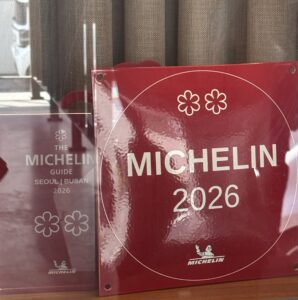
The Seoul restaurant has earned two Michelin Stars, while its New York location has been awarded three Michelin Stars.
Inside JUNGSIK SEOUL

Even before the meal began, the interior caught my attention.
The ceiling design immediately sparked my curiosity.
I pointed at one of the round fixtures and asked,
“Is that a security camera?”
The staff smiled and replied,
“No, that’s actually a speaker.”
It was such a small conversation, but moments like these made the experience even more enjoyable.
Everyone was incredibly kind, and being able to communicate in English made me feel much more comfortable throughout the meal.
JUNGSIK SEOUL Lunch Menu
Korean Banchan-Inspired Starters
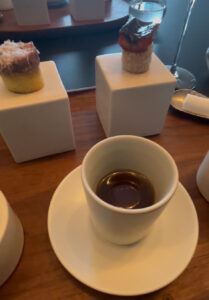
The first course was a rich mushroom soup.
I asked what kind of mushroom had been used, but neither of us knew the English name for it.
So we simply agreed that it was an incredibly flavorful mushroom broth.
It was absolutely delicious.
Throughout the lunch, the staff carefully explained every dish in English.
However, the names of the teas and herbs were quite difficult to remember.
I kept asking questions because I genuinely wanted to learn more, although I was also trying not to become “that guest” who asks too many questions.
Finding that balance became part of the fun.
JUNGSIK SEOUL Beverage Pairing
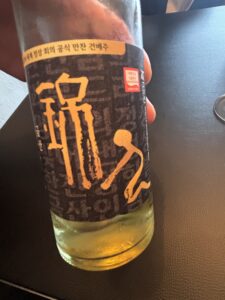
One of the highlights of lunch at JUNGSIK SEOUL was the beverage pairing.
The sommelier introduced a variety of options, including wine, whisky, Korean soju, traditional rice wine, and other carefully selected drinks.
Rather than simply choosing wine, I wanted to experience beverages that reflected Korean food culture.
Following the sommelier’s recommendation, I enjoyed two traditional Korean drinks:
- Illyeop Pyunjoo (일엽편주)
- Chuk (축)
One of them was infused with Korean ginseng.
The sommelier smiled and said,
“It’s good for your health.”
That alone made me curious enough to try it.
I also tasted a traditional Korean rice wine, which paired beautifully with the dishes.
Trying local beverages alongside the food made the entire dining experience feel even more connected to Korean culture.
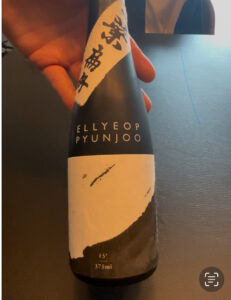
I asked whether the rice wine was produced near Seoul.
The staff explained that the brewery is located near a UNESCO World Heritage area.
Instead of selecting each drink myself, I simply asked,
“Could you recommend pairings that best match today’s menu?”
When the flatfish course arrived together with another carefully chosen beverage, I was glad I had trusted the sommelier.
The pairing enhanced both the food and the drinks, making the experience even more memorable.
JUNGSIK SEOUL Amuse-Bouche
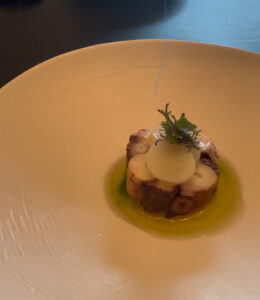
The next course featured a beautifully braised dish topped with shaved truffle.
I immediately recognized it from photos I had seen before visiting JUNGSIK.
It was one of the signature dishes I had been looking forward to trying.
The staff recommended gently breaking everything apart and mixing it with the sauce before eating.
The ingredients had been slowly cooked for a long time, creating an incredibly tender texture without any unwanted richness.
The aroma of the truffle blended naturally with the sauce rather than overpowering it.
Simple, elegant, and absolutely delicious.
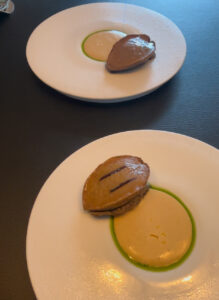
Smoked Abalone
The staff explained that the abalone had been lightly smoked and slowly cooked for around two hours.
Recently, I’ve noticed that many fine dining restaurants seem to enjoy exploring new ways of preparing abalone, so I was curious to see JUNGSIK’s interpretation.
Surprisingly, the texture reminded me more of a perfectly cooked steak than seafood.
The smoky flavor was gentle and well balanced, allowing the natural sweetness of the abalone to stand out.
It was another dish that demonstrated how familiar Korean ingredients can be transformed into something completely different through technique.
Fish and Meat Courses
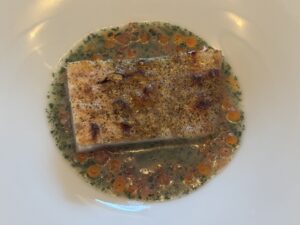
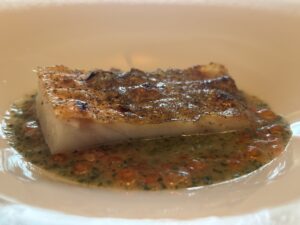
The flatfish was served with salmon roe and a seaweed-based sauce.
The staff suggested starting with the engawa (fin muscle), gently mixing it with the roe and sauce before enjoying the rest of the fish.
The type of fish changes depending on the season, making each visit slightly different.
Throughout the course I asked plenty of questions, and the staff kindly explained every dish.
Looking back, I think I would have appreciated the experience even more if I had known more about Korean herbs and teas.
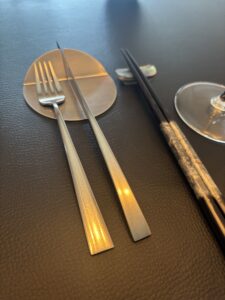
One detail that caught my attention throughout the meal was the cutlery.
From the beginning of the course, I kept wondering why there was a split in the handle.
A little later, I realized it was designed to hold the knife perfectly.
It was one of those satisfying “Aha!” moments that made me appreciate how much thought had gone into even the smallest details.
Discovering thoughtful design like this is one of the joys of visiting fine dining restaurants.
Since Korean beef is highly regarded, I decided to upgrade my main course from duck to Korean Hanwoo beef.
The upgrade cost an additional 30,000 KRW.
The beef was served with a truffle sauce, and the staff explained that the accompanying kimchi had been carefully aged to develop deeper flavors.
The combination of rich beef, earthy truffle, and fermented kimchi created a unique balance that I hadn’t experienced before.
Some guests may find it adventurous, but I enjoyed trying a different interpretation of Korean cuisine.
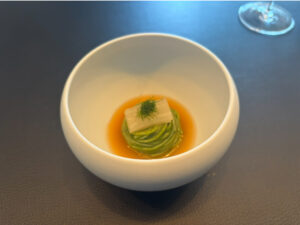
The final savory course featured handmade noodles infused with seaweed, served with Korean radish.
Hidden beneath the broth were pieces of tomato, and the staff recommended mixing everything together before eating.
The combination looked surprisingly simple, yet each ingredient added a different layer of flavor.
The seaweed gave the noodles a delicate aroma, while the tomatoes brought freshness and gentle acidity to the dish.
As I enjoyed the final bites, I couldn’t help wondering whether I could recreate something similar at home with plenty of seaweed.
Probably not—but it was fun imagining it.
Signature Desserts
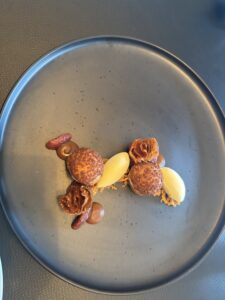
The first dessert was inspired by New York, home to JUNGSIK’s sister restaurant.
Chocolate was shaped into delicate roses and served with caramel sauce and tiny macarons.
It was elegant, playful, and beautifully presented.
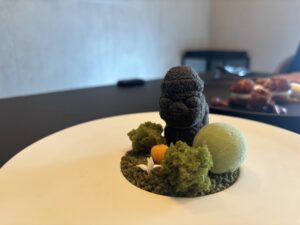
The next dessert immediately caught my attention.
“I’ve definitely seen this face before…”
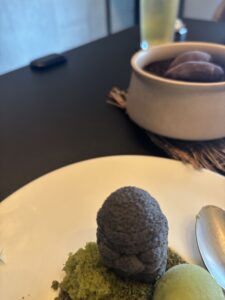
It turned out to be Dol Hareubang, the famous stone guardian statue from Jeju Island.
The outside was coated in chocolate, while the base had a crisp texture.
When I broke it open, matcha ice cream appeared inside.
The staff explained that this was one of JUNGSIK’s signature desserts, and it was easy to see why.
It wasn’t just delicious—it was fun.
I also noticed a tiny mandarin orange decoration and jokingly asked,
“Is that a real miniature orange?”
The staff laughed and replied,
“No, it’s handmade.”
That small conversation somehow made the dessert even more memorable.
Just when I thought the desserts were over, another surprise arrived.
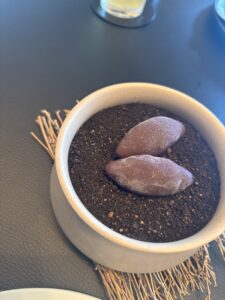
A sweet potato.
At least, that’s what it looked like.
The staff explained that the outside was made of chocolate and encouraged me to crack it open before eating.
Curious as always, I pointed at the soil underneath and asked,
“Can I eat this too?”
The answer came with a smile:
“It’s just decoration.”
Technically edible, perhaps—but it was there simply to complete the presentation.
Moments like this made the entire meal feel playful as well as elegant.
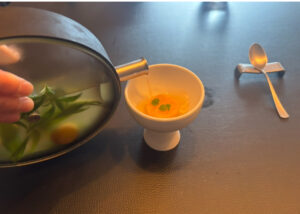
To finish the meal, a refreshing sorbet was served with hot tea gently poured over it.
It was a light, refreshing ending that brought the entire course together beautifully.
Lunch vs. Dinner at JUNGSIK SEOUL
Lunch and dinner offer different tasting experiences.
At the time of my visit, the lunch menu featured two course options, while dinner offered three.
The staff also told me that one of the dinner desserts uses small Korean pumpkins, giving it a charming autumn appearance that reminded me of Halloween.
Even hearing about the dinner menu made me want to return for another visit.
Every course brought a new surprise, whether through flavor, presentation, or the stories shared by the staff.
JUNGSIK SEOUL is more than just a Michelin-starred restaurant.
It is a place where Korean ingredients, craftsmanship, hospitality, and creativity come together to create a memorable dining experience.
For anyone traveling to Seoul with a passion for food, JUNGSIK is a destination worth planning a trip around.